
Think about your possessions. Some of them are probably purely utilitarian. They serve a purpose, such as holding food, or enabling you to fix something, but they have no other meaning to you. But there are objects that we have that connect us to a certain group of people. Maybe you have band merch or a sports jersey because you identify with fans of a certain music artist or sports team. Or certain items from your cultural heritage because you want to feel connected to people of a similar background. Maybe you have luxury accessories (or reasonable facsimiles) because you want to show you are part of a certain socio-economic group. This is human nature. We are social creatures, and want to belong to a group. To a certain extent, there is safety in numbers
I started researching this post with the question “What’s the connection between similar blue and white pottery in China and Netherlands?” As I looked further into this connection, other cultural clouds emerged.

Origins of blue and white
Chinese blue and white pottery started by importing the cobalt blue pigment and some Islamic designs from Iran. Potters in the province of Jiangxi perfected the art and craft. From there, many places in the world adopted this way of making pottery. It travelled to Korea, Japan, and Vietnam based on geographical proximity. Then it caught on in Jaipur, India. Eventually, rich Europeans started collecting Chinese pottery as a display of their wealth. European countries, such as Italy, Spain, Portugal, England, and to a lesser extent, France and Germany created their own versions in this example of culture as a huge recycling project. Eventually, the concept also made its way to the United States and Mexico.

Luxury brand knockoff
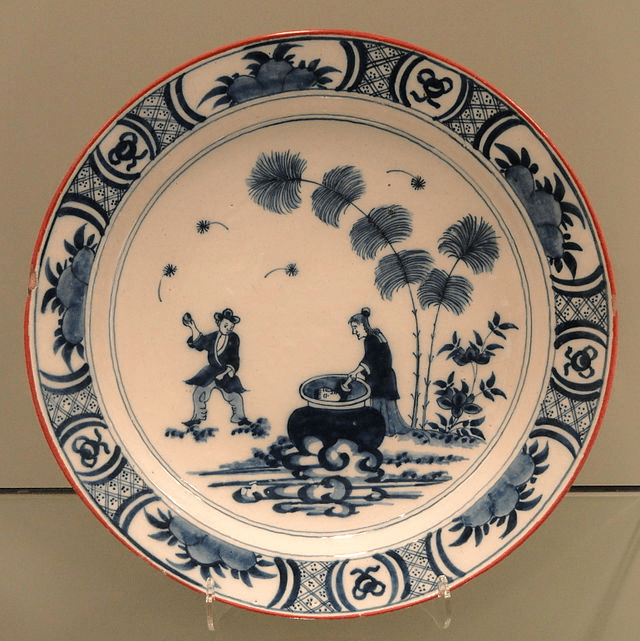
In the Netherlands, Delftware pottery became the most popular of the European imitations. It was a knockoff of the “luxury brand” Chinese pottery. It was made from less expensive materials, and combined Chinese designs with illustrations of Dutch landscapes. They changed symbolic imagery and replaced peaches, which symbolize longevity in Chinese art, with oranges, which seem to be common in Dutch still life paintings at that time. Less wealthy Dutch people could identify with the elite of the day by owning something that looked like a luxury item. Even so, Delftware was sought after by kings and queens of the day.
From status symbol to souvenir
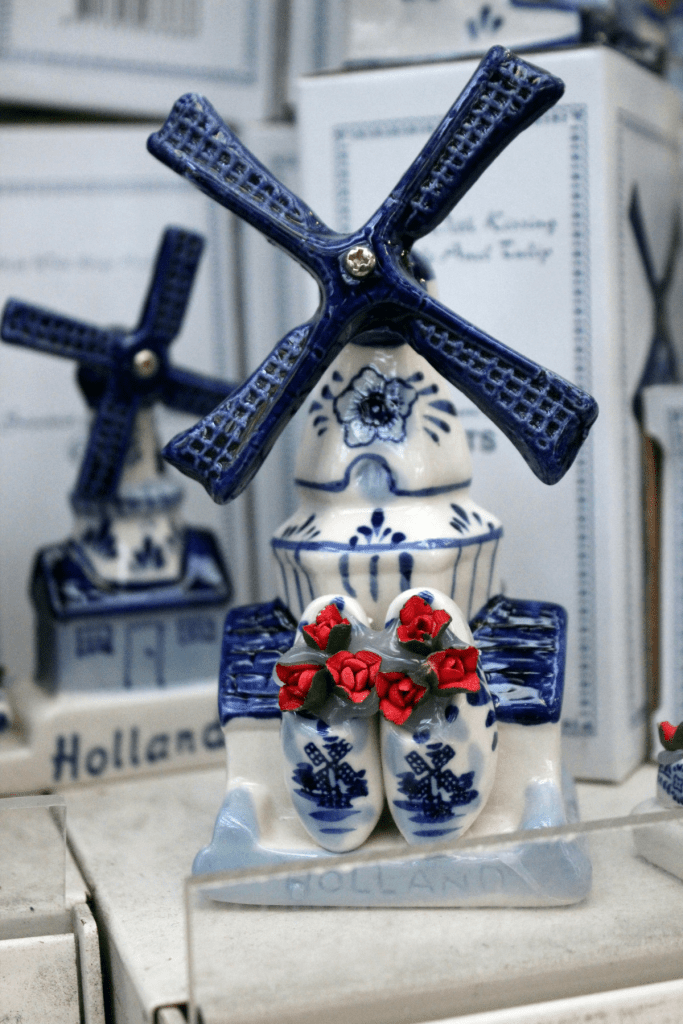
These days, Delftware can be seen for sale as tourist souvenirs in many places in the Netherlands. It is no longer the status symbol it once was, and this meaning has shifted to the clothing and accessories of fashion houses in Europe and America.
Sources:
https://www.bbc.com/culture/article/20200623-delftware-porcelain-the-global-story-of-a-dutch-icon
https://melbourneartclass.com/the-story-of-blue-and-white-pottery/
https://www.adamchau.com/blue-and-white
https://blog.bridgemanimages.com/blog/the-depiction-of-orange
featured image: Charger with Shiba Onko Design, c. 1730, Delft, tin-glazed earthenware with inglaze cobalt – Gardiner Museum, Toronto
 Connecting Clouds

Leave a comment